Mastering Swing Trading Strategies in the Indian Stock Market: A Comprehensive Guide
For working professionals and retail traders in India, monitoring live stock tickers during market hours (9:15 AM to 3:30 PM) is nearly impossible. Intraday trading requires constant attention and split-second execution, while long-term value investing requires months or years of patience before generating returns.
This is where swing trading bridges the gap. By holding positions across a multi-day to multi-week timeframe (typically 2 to 15 trading sessions), swing traders aim to capture momentum moves while spending as little as 30 to 45 minutes a day on market analysis.
However, success in the Indian market—characterized by rapid sector rotations, foreign institutional investor (FII) flows, and event-driven volatility—requires a structured, rule-based framework. This comprehensive guide breaks down high-probability swing trading strategies tailored for National Stock Exchange (NSE) and Bombay Stock Exchange (BSE) stocks.
What Makes Swing Trading Effective in Indian Markets?
Swing trading targets individual price waves or “swings” within a broader trend. When a stock consolidates or pulls back, buyers step in to resume the primary trend, creating predictable patterns on daily and 4-hour charts.
In the Indian financial landscape, swing setups thrive due to:
- Institutional Momentum: Sector rotations driven by FII and DII (Domestic Institutional Investor) liquidity create trend legs lasting 1 to 3 weeks.
- Clear Catalyst Windows: Indian markets present regular short-term catalysts, including quarterly earnings seasons (Q1–Q4 results), RBI monetary policy announcements, and union budget updates.
- High Liquidity in Benchmark Indices: Constituents of Nifty 50, Nifty Next 50, and top liquid mid-caps provide high volume and tight bid-ask spreads, minimizing trade slippage.
The 3 Non-Negotiable Indicators for Swing Trading
Before entering any trade, cluttering your charting platform with dozens of indicators can lead to analysis paralysis. A clean chart with three core indicators provides a complete picture:
- Exponential Moving Averages (20 EMA & 50 EMA):
- Trend Filter: When the 20 EMA is above the 50 EMA and both slope upward on the daily chart, the market is in an established uptrend.
- Dynamic Support: The 20 EMA serves as a high-probability zone for pullback buys during a bull trend.
- Relative Strength Index (RSI – 14 Period):
- Instead of using RSI solely for overbought/oversold levels (70/30), look at the 45–65 range in up trending stocks as a zone of hidden momentum. An RSI bouncing off the 50 level confirms healthy trend continuation.
- Volume Spikes:
- Volume validates price action. A breakout or reversal candle supported by volume 50% to 100% higher than its 20-day average indicates institutional participation rather than retail speculation.
Top 3 Rule-Based Swing Trading Strategies
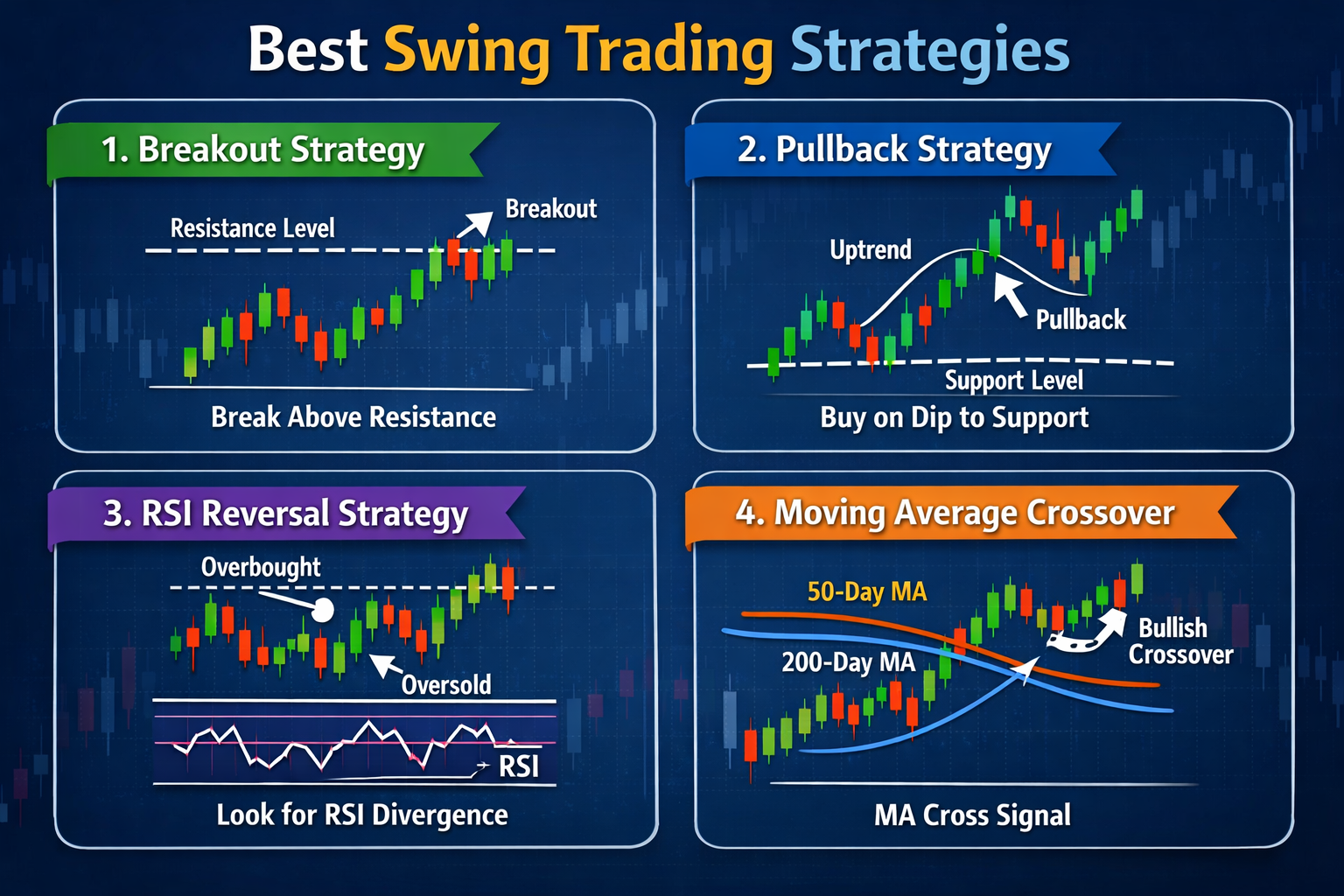
Strategy 1: The 20 EMA Pullback (Buying the Dip)
This is one of the lowest-risk swing setups because it aligns your entry directly with the existing primary trend rather than predicting market tops or bottoms.
The Setup: Identify a stock on the daily chart where the price is trading above the 50 EMA and the 20 EMA.
- The Retracement: Wait for the stock to retrace toward the 20 EMA over 3 to 5 sessions on declining volume.
- The Entry Trigger: Enter on the close of a daily bullish reversal candle (such as a Hammer or Bullish Engulfing pattern) touching or bouncing off the 20 EMA, backed by a surge in volume.
- Stop-Loss: Place your stop-loss 1% below the recent swing low.
- Target: Set your primary target near the previous swing high, aiming for a minimum 1:2 Risk-to-Reward ratio.
Strategy 2: Volatility Contraction Pattern (VCP) & Breakout
Popularized by legendary trader Mark Minervini, the VCP setup captures stocks transitioning from a tight consolidation phase to an explosive breakout phase.
- The Setup: Look for a stock consolidating sideways over 10 to 20 trading sessions. During this period, the price swings narrow (e.g., first a 10% pullback, then 5%, then 2%), and volume dries up significantly.
- The Entry Trigger: Buy when the stock closes above the horizontal resistance line on volume that is at least 1.5x to 2x the 20-day volume average.
- Stop-Loss: Place the stop-loss just inside the broken consolidation range (or below the breakout candle’s low).
- Target: Measure the vertical depth of the consolidation base and project that distance upward from the breakout point.
Strategy 3: Pre-Earnings Drift Momentum
In Indian equities, companies reporting strong quarter-on-quarter earnings growth often experience strong buying momentum 7 to 10 trading sessions prior to their official results announcement.
- The Setup: Screen for mid-cap or large-cap stocks that have consistently beaten earnings estimates over the last 2 to 3 quarters.
- The Entry: Enter the position 8 to 10 trading days before the scheduled earnings release date once the daily chart breaks out of a minor 3-day high.
- The Exit: Exit the trade 1 day prior to the earnings announcement. This allows you to capture the “pre-results drift” while avoiding the binary overnight volatility risk of the actual report.
Risk Management: The 2% Position Sizing Matrix
No matter how refined your technical setup is, an unexpected market gap-down or global macroeconomic event can invalidate a trade setup. Long-term capital preservation relies entirely on position sizing rules.
The 2% Portfolio Risk Rule
Never risk more than 1% to 2% of your total account capital on a single swing trade.
Example Calculation:
- Total Account Capital: ₹5,000,000
- Max Allowed Risk per Trade (2%): ₹10,000
- Selected Stock Entry Price: ₹500
- Defined Technical Stop-Loss: ₹480 (Risk = ₹20 per share)
By risking only ₹10,000 per trade, your account can withstand multiple consecutive losses without suffering catastrophic drawdowns.
The 4 Golden Rules for Indian Swing Traders
- Respect Sector Alignment: Avoid buying an individual stock if its parent sector index (e.g., Nifty IT, Nifty Bank, Nifty Auto) is breaking down below major support levels. Always trade in the direction of sector momentum.
- Never Shift Stop-Losses Downward: A stop-loss is an insurance policy. If the price triggers your exit level, accept the loss immediately. Avoid holding a losing short-term swing trade in the hope that it will turn into a long-term investment.
- Beware of Overnight Gap Risk: Events like US Fed interest rate decisions or geopolitical news occur outside Indian market hours. Maintain a balanced portfolio allocation (e.g., 3 to 5 open positions at a time) rather than putting all capital into one stock.
- Log Every Trade: Keep a simple trading journal recording your entry price, stop-loss level, exit target, setup pattern, and emotional state. Reviewing your performance at the end of each month will highlight which strategies yield the highest win rates for your trading style.
By committing to a systematic, rule-based approach, swing trading offers a realistic path to consistent portfolio growth in the Indian stock market without demanding all-day screen time.
No responses yet